


Jungle Safari in Ranthambore
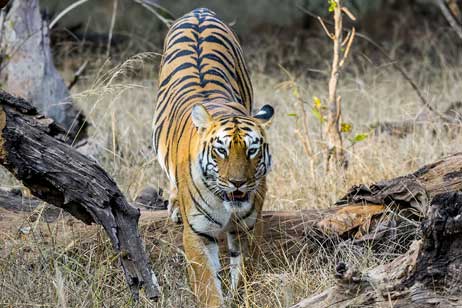
Ranthambore National Park is a favourite wildlife destination among wildlife lovers. Located in Rajasthan’s Sawai Madhopur district, Ranthambore is home to several species of plants, animals and birds. Among the animal species, the Bengal tigers are the prime attractions, and tourists flock here to get a glimpse of the majestic big cats. Tourists and wildlife enthusiasts in particular visit Ranthambore in large numbers every year. The majestic glory of the Ranthambore forest can be well explored by opting for a safari ride. Ranthambore National Park is divided into 10 distinct safari zones. Hence, it is quite evident that the national park is spread across a vast area. Therefore, it is suggested to book at least 3-4 safaris, so that the 3-4 safari zones can be explored.

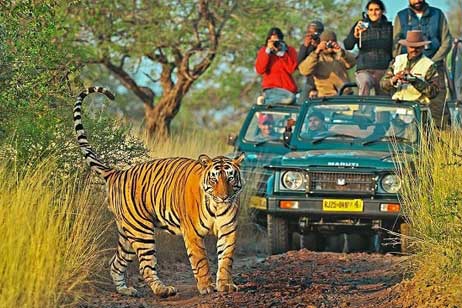
The wildlife safaris in Ranthambhore National Park are completely organised by the forest department, and the officials manage the entire operation as per the norms issued by the government. Please note that no private vehicles are allowed inside beyond the entry gates of the safari zones. Tourists coming to Ranthambore by their own car can park their vehicle in the chosen accommodation. In order to enter the Ranthambore safari zones, visitors have to choose among the safari vehicles available in Ranthambore. Ranthambore safari tour is the only option to visit deep in the Jungle and get a chance to sight a tiger.
2 types of safari tours are available in Ranthambore -
1. Jeep Safari 2. Canter Safari The safaris in the Ranthambore zones not only facilitate spotting of the exotic species of flora and fauna, but also several scenic viewpoints of ruined structures, ancient temples and ponds. Apart from wildlife and other spots, the Ranthambore Fort is another iconic attraction inside the forest of Ranthambore National Park. This massive ancient structure, standing proudly amid the wilderness, is an exceptional experience during the Ranthambore wildlife tour. The fort can be
explored separately, and a couple of hours need to be dedicated to discover the history of the fort thoroughly.
Safari Booking of Rahtambore National Park
As mentioned above, jeep and canter safaris are operated to explore Ranthambore National Park, • A jeep can accommodate up to 6 people and a driver, and a guide. • A canter can accommodate up to 20 people and a driver and guide. Tourist can book their Ranthambore safari online for prior reservation of a jeep or a canter through our online portal of safari booking. We provide both jeep and canter safaris and assist with advance booking of seats based on the visitor’s preference. The payment process has to be completed online while booking online through us. Note: The Ranthambore safaris are to be booked in advance, a maximum of 90 days prior.
The charges of the Ranthambore safari booking include -
• Vehicle charges • Guide • Permit Both canter and jeep safaris are operated in the morning and the evening slots. Morning Slot: 6:00 am - 9:30 am Evening Slot: 3:30 pm - 7:00 pm (The Ranthambore safari timings vary seasonally) The time slots are the same for both jeep and canter safaris in Ranthambore. The safari duration is around 3.5 hours, enough to explore the safari zone completely. Visitors can explore only one safari zone at a time. The entire 3.5 hours of the safari is dedicated to a single zone. In order to explore more than one Ranthambore safari zone, tourists need to book multiple safaris separately.
Ranthambore Safari Booking Window
• For advance booking: 90 days prior to the visiting date • For Tatkal booking: 7 days prior to the visiting date • For premium Tatkal booking: 3 days prior to the visiting date • For current-day booking: 1 day before the visit date for morning safari, and for afternoon safari, safaris can be booked after 10 am on the same day.
Tatkal Gypsy Slots
• Zones 1 and 5 Morning Safari: 2 Gypsies Evening Safari: 2 Gypsies • Zones 2, 3 and 4 Morning Safari: 1 Gypsy Evening Safari: 1 Gypsy Tatkal Canter Slots • Zones 1, 2, 3 and 4 Morning Safari: 1 Canter Evening Safari: 1 Canter
Few Points to Consider
• For advance safari booking, tourists need to pay the normal charges as fixed for jeep and canter safaris • For Tatkal, Premium Tatkal and same-day booking, additional charges are applicable. • Please be informed that safaris are provided purely based on availability. • If not booked in advance, tatkal or premium tatkal booking does assure a guaranteed safari. • Tourists can only secure safari seats on Tatkal, if at all available. • During the peak tourist season, that is from November to March, it is difficult to arrange a safari if not booked earlier. • The safari seat booked in one’s name cannot be transferred to any other individual.
Why book the Ranthambore Wildlife Safari from us?
The safari seats on both jeeps and canters are allotted on first-sum-first basis. Many tourists, especially first-time visitors, might get confused with the entire online safari booking process. Booking through us can waive off the difficulties. We take care of the complete process on behalf of the tourists. We help in getting tourists confirmed safari seats and complete the payment process in a hassle-free manner. All they need to do is to provide the necessary details like the date, any preferred safari zone and slot, identity proof, total number of travellers and a few more. Once tourists book through us, they can sit back and relax. When planning their next Ranthambore safari tour, we will be at the top of their priority list based on their previous experience. Note: The fees are non-refundable in any situation after the confirmed booking.
Online Booking Procedures for the Jeep and Canter Safari
To book your seat in the Jeep or Canter Safari, you have to follow the following procedures and provide the required information regarding all the visitors.
- Visit the online safari booking page: Click Ranthambore Booking
- Provide all the required information about each visitor: Full name, Age, Sex (as printed on the ID proof provided by you)
- Choose the Date for the safari & Safari timing ( Morning/Afternoon )
- Choose the type of Vehicle ( Jeep/ Canter )
- Provide Identity card numbers of all visitors: For Indian Nationals: Voter ID No., Aadhar Card No., Pan Card No., Driving License No. or any other Govt. ID.)
- For the Foreign Nationals: Only the passport is valid as the Identity card
- Pay the Safari Entry Fees in advance
- Please carry the same ID card at the time of the safari that is submitted during the online booking.
- Booking of Jeep/ Canter safari in Ranthambhore National Park is subject to availability.
- Safari zones are allotted randomly at the time of safari, so no zone preference is entertained.
- You will be picked up from your boarding place in Ranthambhore before your scheduled safari.
Terms & Conditions for Ranthambore Wildlife Safari
- No refund or cancellation will be entertained after the confirmed booking.
- The entry permits are non-transferable and non-exchangeable
- In case of any changes to safari charges, visitors will be informed. The extra amount has to be paid by the visitors.
- The Government of Rajasthan reserves the right to cancel safaris under any unforeseen circumstances.
- The opening and closing times may be changed, or the park or any particular zone may be closed without any prior notice in case of any emergency.
- Visitors are required to submit a photocopy of their Identity proof at the entrance before the entry into the park.
- The original ID proof will be checked at the time of entry.
- No extra charges are applied for using the still camera.
- Terms and Conditions are subject to change, may be appended or amended without prior notice or information due to various government policies.